





Small hospitals take biggest hit in Medicare bad debt pay cut
A proposal to replace the payments also has drawn hospital concern.

Small, rural, critical access hospitals (CAHs) would see the largest adverse financial effects from cuts to Medicare bad debt payments, which are under consideration in Congress, according to new research.
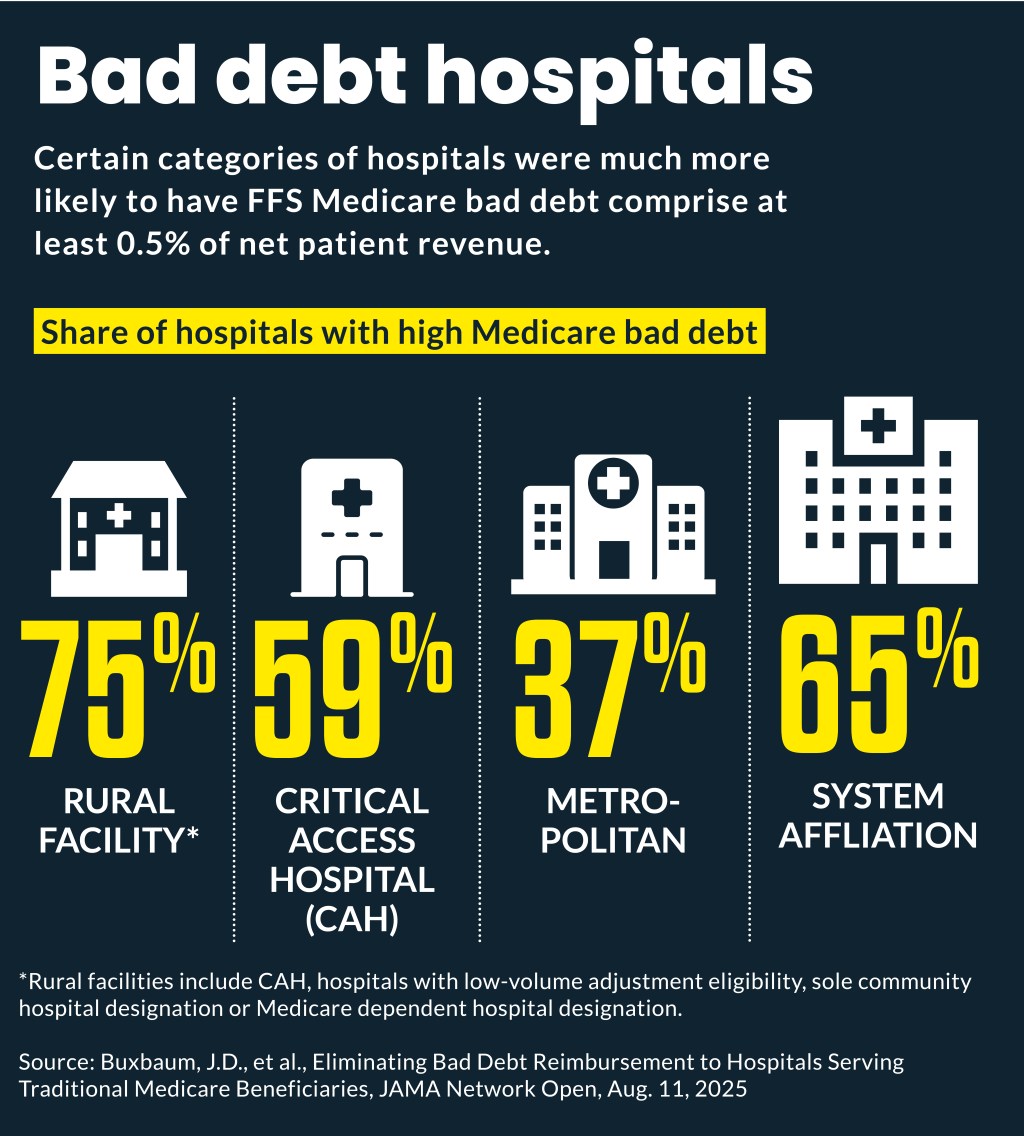
The study, published in JAMA Network Open, identified the characteristics of hospitals where fee-for-service (FFS) Medicare bad debt was at least 0.5% of net patient revenue.
The research came as Congress has proposed phasing out Medicare bad debt payments. A list of healthcare cost savings proposals issued early in the legislative process for the recently enacted reconciliation bill, projected $42 billion in 10-year federal savings from phasing out those payments.
The payments cover 65% of the cost sharing not paid by FFS Medicare enrollees. Payments require hospitals to take reasonable efforts to collect the debt.
Findings
The study found that out of 3,952 hospitals that reported Medicare-eligible bad debt in 2023, there were 848 that reported bad debt of at least 0.5% of net patient revenues. That year, total Medicare bad debt was $2.5 billion and a mean of $593,942 per hospital.
Characteristics of high bad-debt hospitals included:
- Smaller (mean 64.7 beds)
- Higher ratios of Medicare bad debt to beds
- Lower operating margins (mean −0.6%)
- CAHs (497 of 848 hospitals with high bad debt)
Many of those affected hospitals (552) also had a system affiliation but that arrangement was less common than the share of system-affiliated hospitals, overall (65% vs. 79%).
Hospitals in California, Texas, and Florida collectively reported nearly $725 million in bad debt. Although hospitals with high bad debt were disproportionately located in the upper Midwest, the difference was moderate, said Jason Buxbaum, PhD, one of the authors and an assistant professor at Brown University School of Public Health.
Sources of Medicare patients’ bad debt include their annual inpatient deductible and 20% coinsurance for outpatient and physician services.
Why cut proposed
The current congressional proposal to cut Medicare bad debt payment is only the latest to do so. The Simpson-Bowles deficit commission and others previously proposed cuts to, or elimination of, Medicare bad debt payments.
Those proposals frequently stem from a belief that hospitals don’t do enough to collect cost-share from seniors and the disabled and that Medicare should not pay for bad debt since commercial payers do not cover it.
Hospital advocates have countered that hospitals only receive bad debt payments after following a regulatorily required collection process, which then draws criticism for pursuing payments from seniors and the disabled. Additionally, hospitals are barred from collecting debt for the millions of patients who are dual eligibles.
They also note that Medicare differs from commercial insurance in fundamental ways, including its use of fixed prices, compared to hospitals’ ability to negotiate prices with commercial payers.
“Hospitals that treat disproportionally high levels of low-income Medicare beneficiaries, in particular, would further struggle to make ends meet and could be forced to cut vital services to patients,” said a blog from the Federation of American Hospitals, in response to a previous proposal to cut Medicare bad debt payments.
Another way
The existing Medicare bad debt collection requirements are costly and payments are poorly targeted, said Buxbaum.
“Policymakers would do well to step back and critically assess these bad debt policies,” Buxbaum said in an email. “Administratively, requirements to collect are very cumbersome. Documenting each collection effort, preparing logs in a way that will be acceptable to the Medicare program — this work generally isn’t automated, and it isn’t an efficient use of hospitals’ time.”
The Medicare Payment Advisory Commission (MedPAC) proposed a Medicare Safety Net Index (MSNI) to assess hospitals’ financial needs. Under that approach, Medicare would redistribute existing disproportionate share hospital and uncompensated care payments to hospitals and increase the MSNI pool by $4 billion. That pool would be eligible to pay bad debt for both FFS and Medicare Advantage patients.
“This would be a far simpler, less cumbersome way to support the most at-risk hospitals,” Buxbaum said.
However, the MedPAC proposal has drawn criticism from safety-net hospital advocates. America’s Essential Hospitals wrote in opposition to it for reasons that included its effect of shifting “funding away from the largest safety net providers that serve the highest numbers of low-income Medicare patients.”
